
Forum Numerica - Els LEFEVER: Beyond the Right Answer: How Large Language Models Represent Meaning and Reason About Alternatives.
- Abstract
-
Large language models achieve remarkable performance across languages and reasoning tasks. Yet, high benchmark scores tell us relatively little about what models actually learn, how they represent meaning internally, or how they reason when information is incomplete or ambiguous. In this talk, I explore these questions by combining insights from mechanistic interpretability and defeasible reasoning, two complementary approaches to understanding the inner workings of language models.
First, I examine how multilingual language models represent meaning at the neuron level. Using cross-lingual emotion detection as a case study, I show that multilingual representations are neither entirely shared nor fully language-specific. Analyses of neuron activations reveal a dual structure, with polyglot neurons capturing semantic information shared across languages and monolingual neurons reflecting language-specific patterns. These findings provide a more nuanced picture of what multilingual models actually learn and how knowledge transfers across languages.
I then shift the focus from how information is represented to how models reason about competing interpretations. Defeasible reasoning offers an interesting test case because conclusions may need to be revised as new evidence becomes available. Through experiments with counter-hypotheses, I show how explicitly considering alternative explanations can improve reasoning, particularly when generating evidence that challenges an initial hypothesis. I also explore how targeted questions can help models identify multiple plausible interpretations of the same situation.
Together, these studies illustrate why understanding language models requires looking beyond their final predictions. By examining their internal representations and the alternative hypotheses they consider, we gain a better understanding of how language models process information, where their reasoning succeeds, and where important limitations remain. - About the speaker
-
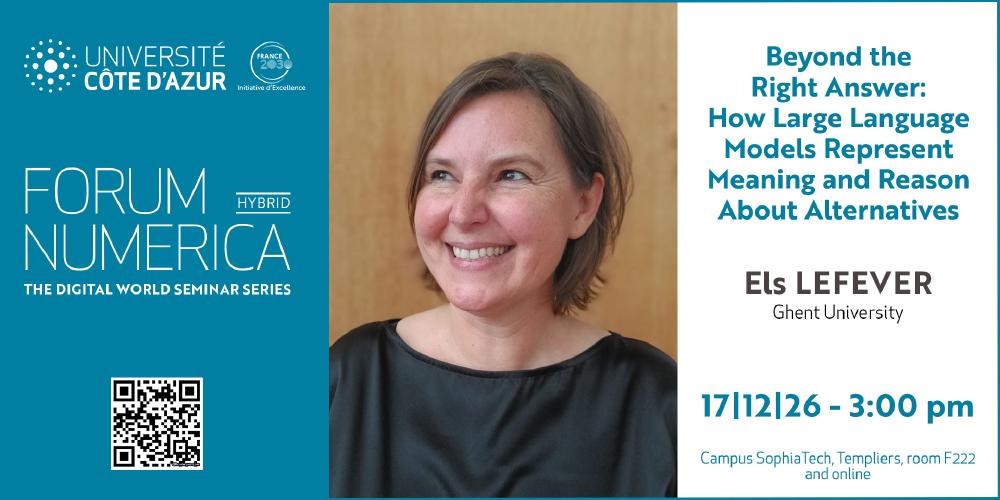
Els Lefever is associate professor at the LT3 language and translation technology team (Ghent University). She holds a PhD in computer science on ParaSense: Parallel Corpora for Word Sense Disambiguation (2012). Els has a strong expertise in machine learning of natural language and multilingual natural language processing, with a special interest for computational semantics, language modeling of lower-resourced languages and multilingual terminology extraction. She currently supervises research on complex reasoning in large language models, argumentation mining in social media, the automatic detection of irony, stereotypes and bias in online text, multimodal emotion detection and generation, and NLP approaches for low(er)-resourced languages, such as cuneiform, Byzantine Greek, or historical travelogues.